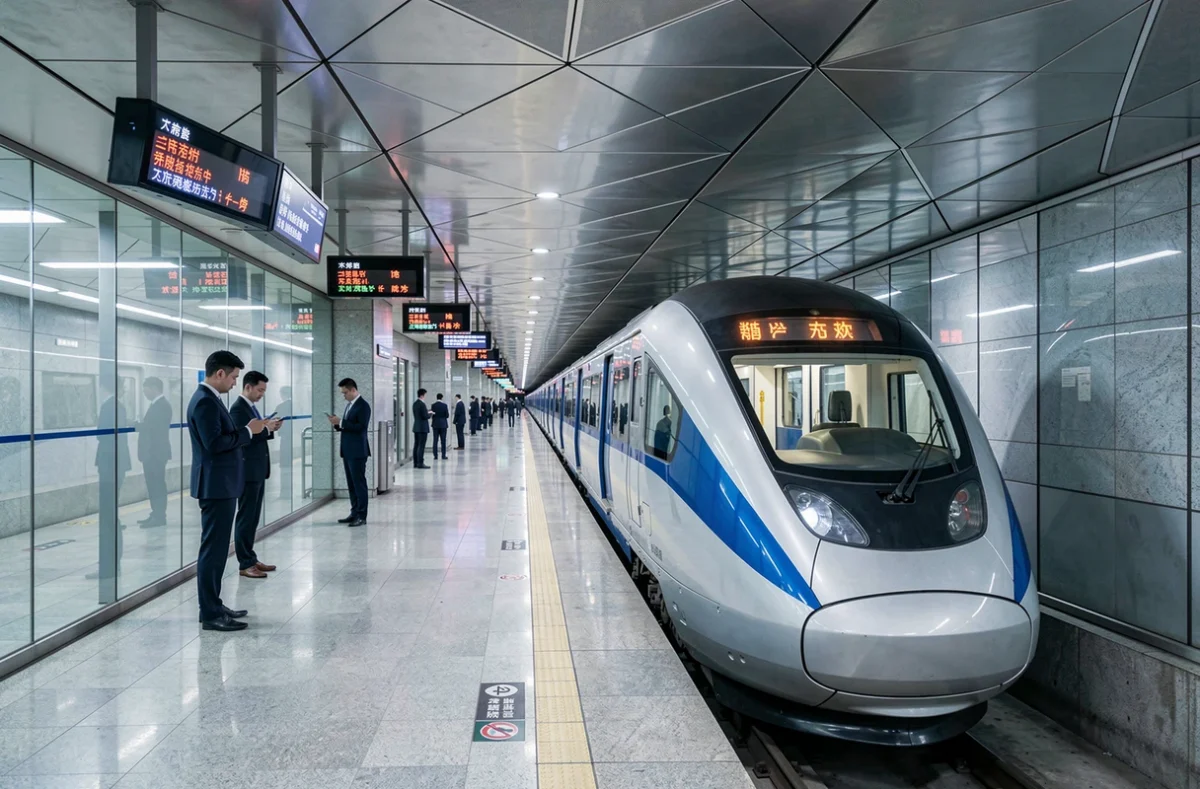
The speed of a metro rarely depends solely on the rolling stock. Between signaling technology, station spacing, and tunnel layout, performance gaps between two networks can exceed several tens of km/h in daily operation. The ranking of the fastest metros in the world in 2024 primarily reflects infrastructure and automation choices that vary significantly from one continent to another.
Maximum speed and commercial speed: two very different rankings
Have you ever noticed that a metro seems fast on one stretch, then slows down considerably on another? That’s the difference between peak speed and commercial speed. The former corresponds to the maximum that the train can reach between two stations. The latter incorporates stops, acceleration phases, braking, and station dwell times.
A network that shows a high maximum speed can be very average in commercial speed if its stations are spaced just a few hundred meters apart. Conversely, a metro with stations spaced several kilometers apart, like some suburban lines in China, achieves commercial averages well above those of older European networks.
Commercial speed is the only reliable indicator for comparing metros, as it determines the actual travel time for users. Rankings that mix peak speed and commercial speed can be misleading, and this is precisely what makes it difficult to establish an indisputable global ranking.
For a detailed overview of performance by line, the resource that lists the fastest metro in the world according to Voyagoo provides a structured overview of operational data published by operators.
CBTC signaling and automation: what really speeds up a metro
Most of the speed gains achieved in recent years do not come from more powerful engines. They come from signaling. The CBTC (Communication-Based Train Control) system allows trains to run closer together while maintaining safety. The result: intervals decrease, frequency increases, and trains spend less time waiting.

An automated driverless metro eliminates human reaction time. Braking and acceleration are managed by algorithms, allowing each segment to be operated as close to the maximum allowed speed as possible. The Riyadh metro, which began operations in late 2024, uses this CBTC technology in fully automatic mode.
Automation is not limited to pure speed. It affects regularity, punctuality, and the capacity of the line. A metro that runs at moderate speed but without any disruptions often offers a travel time that is lower than that of a theoretically faster network that is subject to frequent slowdowns.
The technical factors that differentiate fast networks
- Station spacing: the farther apart the stations are, the longer the train can reach its cruising speed, improving the commercial average
- Track profile: straight lines and deep tunnels without sharp curves allow for maintaining high speeds without intermediate braking
- Type of signaling: CBTC systems and their evolutions (GoA3, GoA4) allow for reduced intervals and optimized continuous driving
- Power supply: some recent networks use higher voltages, providing greater acceleration power to the trains
Riyadh Metro in 2024: a new network that changes the game
The Riyadh network is a remarkable case study. Launched in phases starting in December 2024, it was designed from the outset to operate without a driver across all its lines. It is one of the largest fully automated networks in the world upon its inauguration.
What sets Riyadh apart is the absence of legacy. The metros of Paris, London, or New York must contend with century-old infrastructures, narrow tunnels, and curves inherited from 19th-century urban layouts. Riyadh was able to design its lines on relatively open terrain, with spaced stations and straight segments favoring speed.
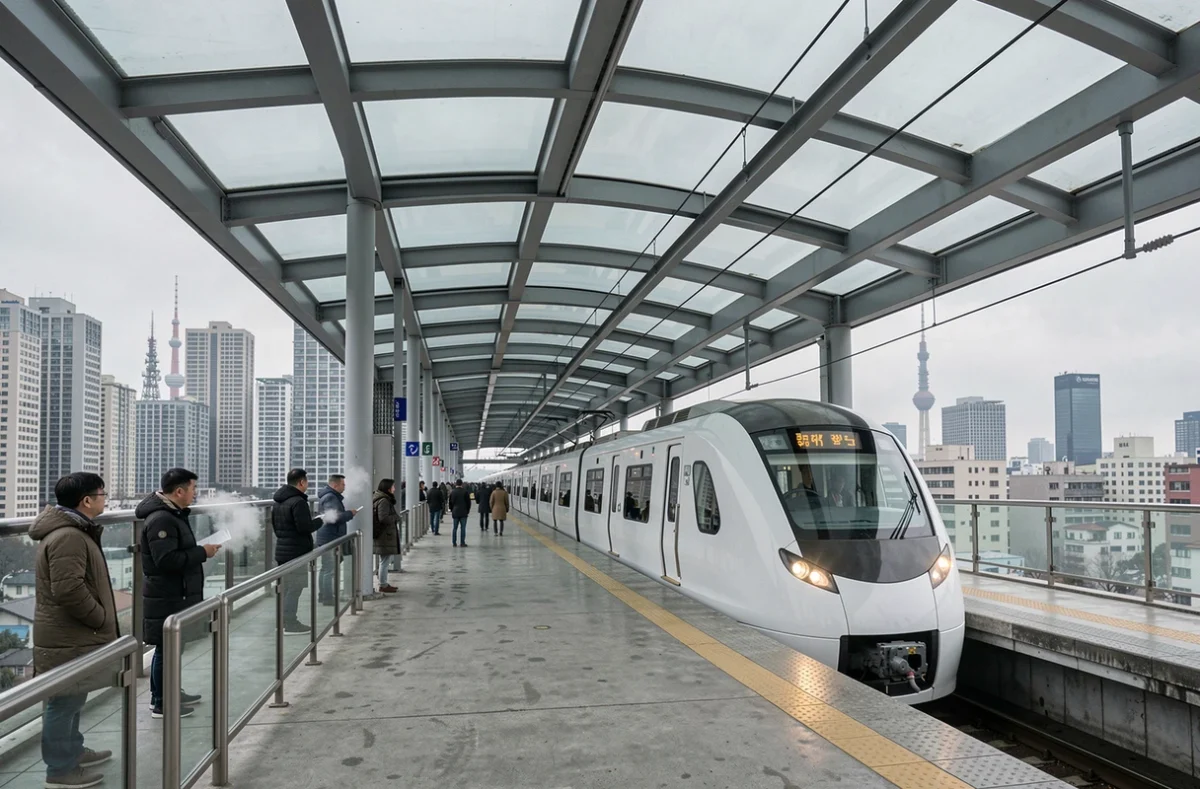
The Saudi network illustrates a fundamental trend: the fastest metros are now those built in the 21st century, in cities that did not have a pre-existing urban rail network. This logic explains why several Asian and Middle Eastern metros now surpass historically renowned European networks.
Why Chinese metros dominate speed rankings
China has built more metro lines in twenty years than Europe has in a century. Shanghai, Beijing, Guangzhou, Shenzhen: these cities operate networks where some lines achieve commercial speeds significantly higher than the global average.
The explanation lies in urban geography. Chinese megacities extend over tens of kilometers. To connect peripheral neighborhoods to the city center, express metro lines cover long distances with few stops. Some Chinese lines operate more like express trains than traditional urban metros.
This model raises a question of definition. Where does the metro stop, and where does the fast suburban train begin? The boundaries are blurred, and international rankings do not always make consistent distinctions. A network like Shanghai’s mixes purely urban lines, with stations every 800 meters, and suburban lines with stops spaced several kilometers apart.
Paris in this global landscape
The Paris metro, with its closely spaced stations and winding tunnels, has one of the lowest commercial speeds among major capitals. The Grand Paris Express, currently being deployed, aims to change the game with automated lines and more spaced stations. But even with these improvements, Paris will remain far from the performance of networks built on virgin ground.
The ranking of the fastest metros in the world in 2024 confirms a clear geographical shift. Recent networks in Asia and the Middle East, designed with the most advanced technologies and freed from historical constraints, now set the performance standards. For European metros, modernization is less about pure speed than about automation and optimizing intervals.