
Organizing a wedding generates a mental load proportional to the number of decisions to be made, not to the size of the celebration. The difference between a calm couple and an exhausted couple on the big day often comes down to a few overlooked contractual and logistical decisions made during the preparations. This article isolates the areas where method discrepancies have the most impact on actual stress levels.
Contractual clauses from vendors: the real anti-stress lever for weddings
Most wedding planning guides recommend “choosing your vendors wisely.” Few detail what happens when an unforeseen event occurs and the contract does not protect the couple.
The general terms of sale of a photographer consulted in September 2026 stipulate that the amounts paid are retained in case of client cancellation. A postponement depends on the vendor’s availability and may not be guaranteed. This logic is found among many wedding professionals, from caterers to DJs.
Before signing, several points deserve careful reading. Simplifying wedding planning with La Perle – A Wedding House also involves good anticipation of these contractual aspects.
- The amount and conditions of the deposit: check if it is refundable in case of cancellation or postponement, and within what timeframe.
- The weather clause: weather conditions do not necessarily justify the cancellation of a service. The vendor can adapt their work without granting a refund.
- Travel and logistics fees: some contracts charge extra fees beyond a certain perimeter, which increases the final bill.
- The delivery time for photos or videos, often absent from initial discussions but a source of frustration after the ceremony.
Reviewing each contract with these criteria in mind significantly reduces financial and logistical surprises.

Weather Plan B for a wedding: formalize the fallback in each contract
The weather Plan B appears in almost every article on wedding planning. However, the question of its contractualization is rarely addressed.
Industry professionals recommend specifying the backup room or structure, its capacity, the switch-over timeframe, and the decision-maker at the time of signing the venue. The fallback decision should ideally be made between 48 and 24 hours before the day.
This framework avoids two common scenarios: the couple discovering on the morning of the event that the backup tent is not set up, or the venue imposing a fallback in a room too small for the expected number of guests.
What the venue contract should mention
The document must specify the exact fallback space (not just “a solution will be found”), the number of guests that this space can accommodate, and who makes the final decision to switch. Without these details, the Plan B remains an intention, not a guarantee.
For decoration, planning an adaptable version rather than two distinct setups limits costs and logistical stress. A table set up under a marquee requires different fixtures than a table indoors, a detail that the decoration vendor must integrate from the quote stage.
Wedding budget: identifying often invisible logistical costs
The budget for a wedding is built around visible items: venue, catering, entertainment, photos. Overruns often come from items the couple did not anticipate.
| Budget item | Often planned | Often forgotten |
|---|---|---|
| Venue | Room rental | Cleaning fees, deposit, overtime |
| Guests | Meals and drinks | Accommodation, shuttles, parking |
| Bride’s outfit | Dress purchase | Alterations, accessories, dry cleaning |
| Photos and video | Day service | Travel, prints, album |
| Decoration | Flowers and centerpieces | Furniture rental, delivery, setup |
Recent sources identify guest accommodation and shuttles as the most underestimated items. A wedding in a rural venue with a majority of guests coming from afar can see this item represent a significant portion of the total budget.
Alterations and additional costs for the wedding dress
The displayed price of a wedding dress almost never corresponds to the final cost. Alterations represent an additional budget that few couples anticipate when choosing the outfit. Adjusting a bodice, shortening a train, or modifying sleeves involves several fittings and specific expertise.
Incorporating these costs from the selection phase allows for comparing dresses based on their actual cost, not just their display price.
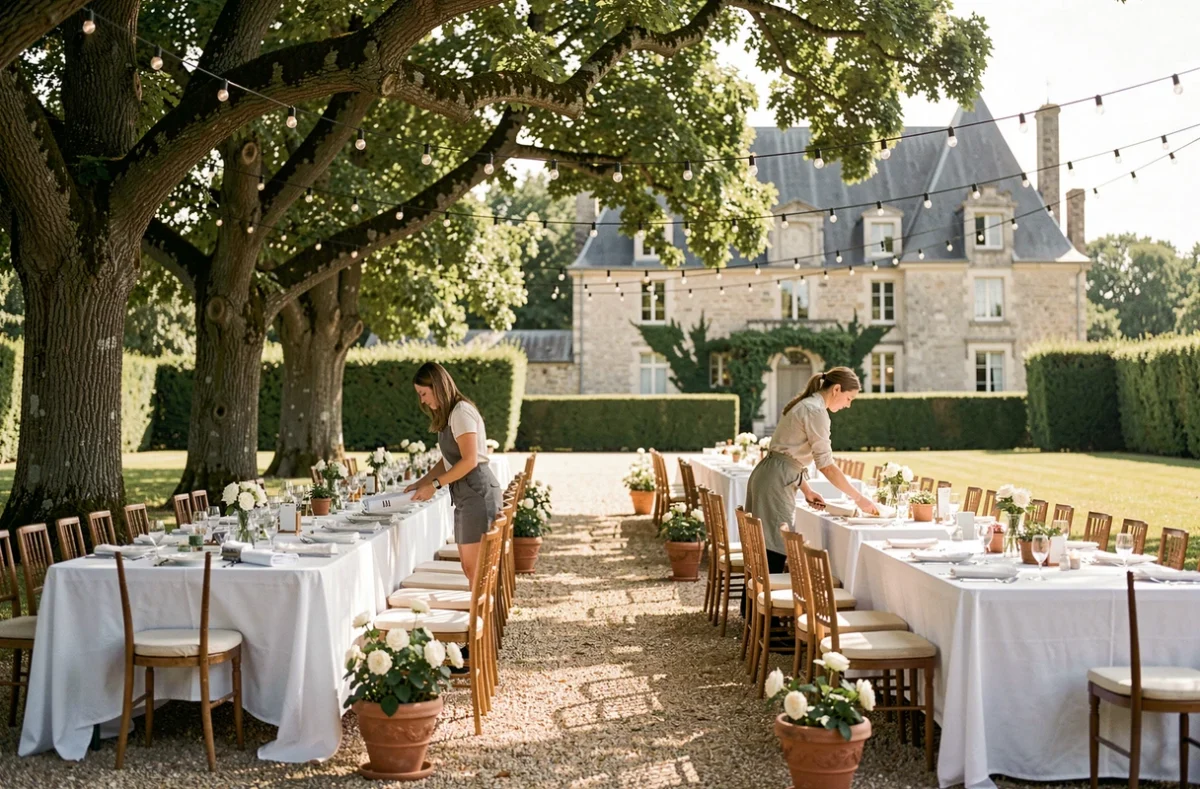
Task distribution between the couple and relatives on the big day
Delegating is a recurring piece of advice. The problem lies in the vagueness of delegation: telling a witness “you handle the coordination” without a specific checklist amounts to not delegating at all.
Each delegated task must be associated with a time, a place, and a contact person. For example, receiving flowers at 9 AM at the entrance of the venue, with the florist’s number in case of delay. This level of detail in the planning frees the couple from mental load on the day of the ceremony.
Practical sheets distributed to relay persons (witnesses, close family, coordinator) work better than a single document. Each person only consults what concerns them, which reduces errors and oversights.
A broad timing between each step of the day absorbs delays without causing panic. Industry professionals find that the most serene weddings are those where the planning allows for margins, not those where every minute is optimized.
Planning a stress-free wedding relies less on ever-longer lists than on the quality of commitments made with each vendor. A precise contract, a formalized Plan B, and a budget that incorporates invisible items cover most sources of tension. The rest belongs to the day itself.