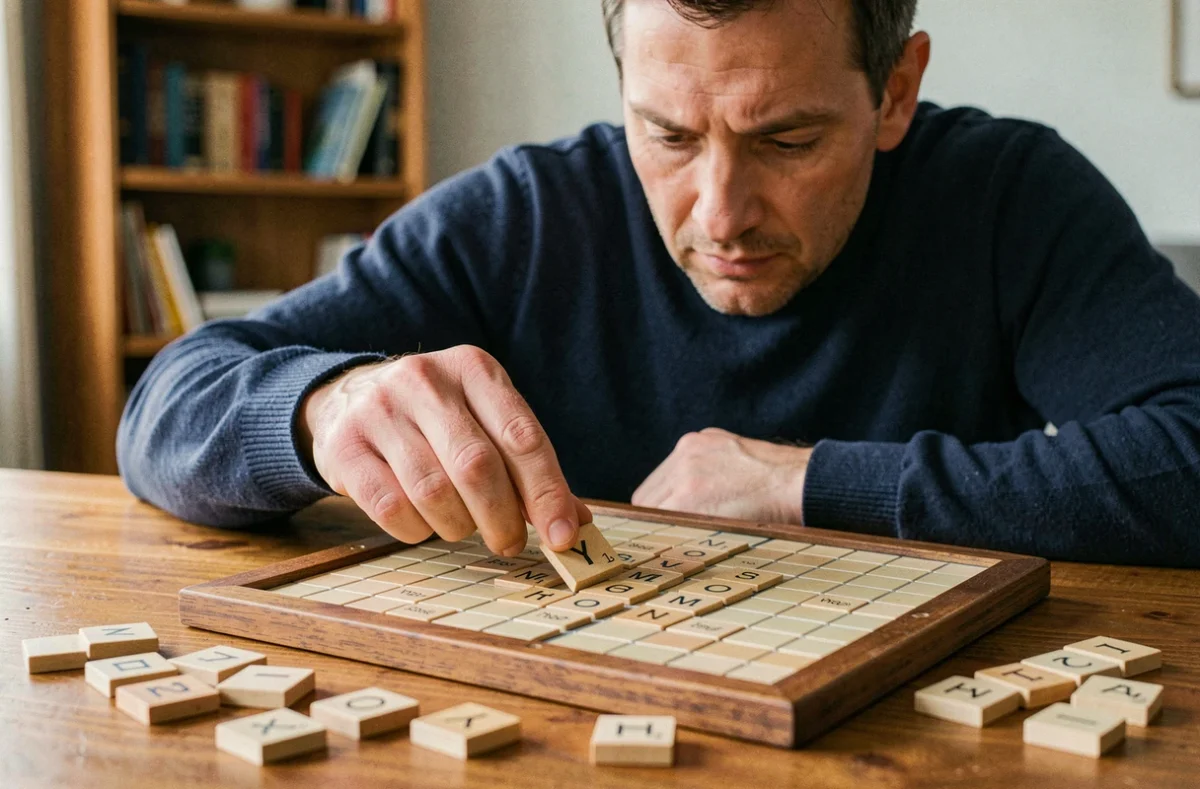
In French-language Scrabble, a word’s validity depends on a single reference: the Official Scrabble Dictionary, commonly known as the ODS. Despite being widely used in speech as an informal interjection, the word “yo” does not appear in this authoritative dictionary. It is therefore not allowed in official play.
The answer seems simple, but it raises a broader question: when two online word checkers give conflicting verdicts on the same word, which one should you trust?
How reliable are online Scrabble word checkers?
Several websites let you check whether a word is valid in Scrabble in just a few seconds. The problem is that their answers don’t always match. When it comes to “yo,” some platforms mark it as invalid, while others leave room for doubt or link it to definitions from Wiktionary without clearly stating whether it appears in the ODS.
This discrepancy comes down to the sources they use. A site may rely on a general dictionary (Wiktionary or collaborative dictionaries) rather than the ODS. However, only the ODS is authoritative in official competition. A word appearing in Larousse or an online dictionary is not automatically allowed in Scrabble, and the reverse is also true.
To settle the question, the French Scrabble Federation (FFSc) provides an official word checker. If a player finds that the word yo in Scrabble gets conflicting results across different sites, the only reliable option is to check the federation’s tool or the printed ODS itself.
- Unofficial word checkers may use lexical databases that differ from the ODS, leading to inaccurate results.
- Some sites show definitions from general dictionaries without stating whether a word is valid in Scrabble.
- The FFSc word checker and the ODS are the only two recognized references in tournaments.

Why “yo” isn’t in the Scrabble ODS
The ODS is not simply a French-language dictionary. It is a closed list, updated periodically, that selects words according to strict lexicographic criteria. To be included, a word must meet several conditions: it must be attested in written sources, have sufficiently documented usage, and not be exclusively oral or fleeting slang.
“Yo” is an interjection borrowed from North American English and popularized by hip-hop culture. In French, its use is largely limited to speech and informal exchanges. Interjections used purely in speech have a hard time making it into the ODS, especially when they have no written tradition in French.
The Scrabble dictionary includes other interjections (fi, oh, ah, hé), but these have a long history in written French. “Yo” has not yet reached that threshold.
Valid two-letter words similar to “yo”
Frustration over “yo” often stems from the fact that other two-letter combinations, some less familiar, are accepted. Valid words beginning with Y include “ya,” for example, as well as forms such as “yod” (three letters). However, neither “yo” nor “yi” appears on the official list.
Two-letter words are a major tactical asset in Scrabble. They let you connect to words already on the board and score points across multiple lines at once. Mastering the full list of accepted two-letter words gives you a considerable advantage, especially toward the end of the game when space is limited.
The ODS and general dictionaries follow different rules
A common misconception is that a word “exists” as soon as it appears in an online dictionary. In Scrabble, the question is not whether a word exists in the language, but whether it appears in the game’s official reference.
Larousse and Le Robert include words according to their own editorial policies, including neologisms, anglicisms, and regional terms. The ODS follows a different approach, which is sometimes more restrictive and sometimes more permissive. Some technical or archaic words allowed in Scrabble do not appear in any general-purpose dictionary.
This distinction explains why players are surprised to find everyday words rejected while obscure terms are accepted. The ODS does not reflect everyday usage; it contains a lexical corpus approved for the game.
How the ODS is updated
The word list changes with each new edition of the ODS. Some words are added, while others are removed. The committee responsible for these updates draws on changes in the French language documented in authoritative dictionaries.
It is possible that “yo” may one day be added to the ODS if its use in writing becomes widespread enough. For now, that is not the case.

Checking a word before an official Scrabble game
In tournaments, word challenges follow a specific procedure. A player can challenge a word played by their opponent. The word is then checked in the ODS or using the federation’s official tool. If the word is invalid, the tiles are removed from the board and the player loses their turn.
Before a competition, the best way to prepare is to:
- Review the two- and three-letter word lists, which contain many of the trickiest words.
- Use only the FFSc word checker rather than a third-party site to resolve any doubts.
- Check the update notes for the latest edition of the ODS to spot recent additions and removals.
In a friendly game, each table sets its own rules: some players accept every word in Larousse, while others stick strictly to the ODS. Agree on the rules before the game starts to avoid disputes.
So “yo” is still a word you shouldn’t try in competition. Its presence in everyday language is not enough to make it playable. Whenever you’re unsure about a word, the safest approach is to check the federation’s official tool rather than rely on a site with an unknown lexical database.