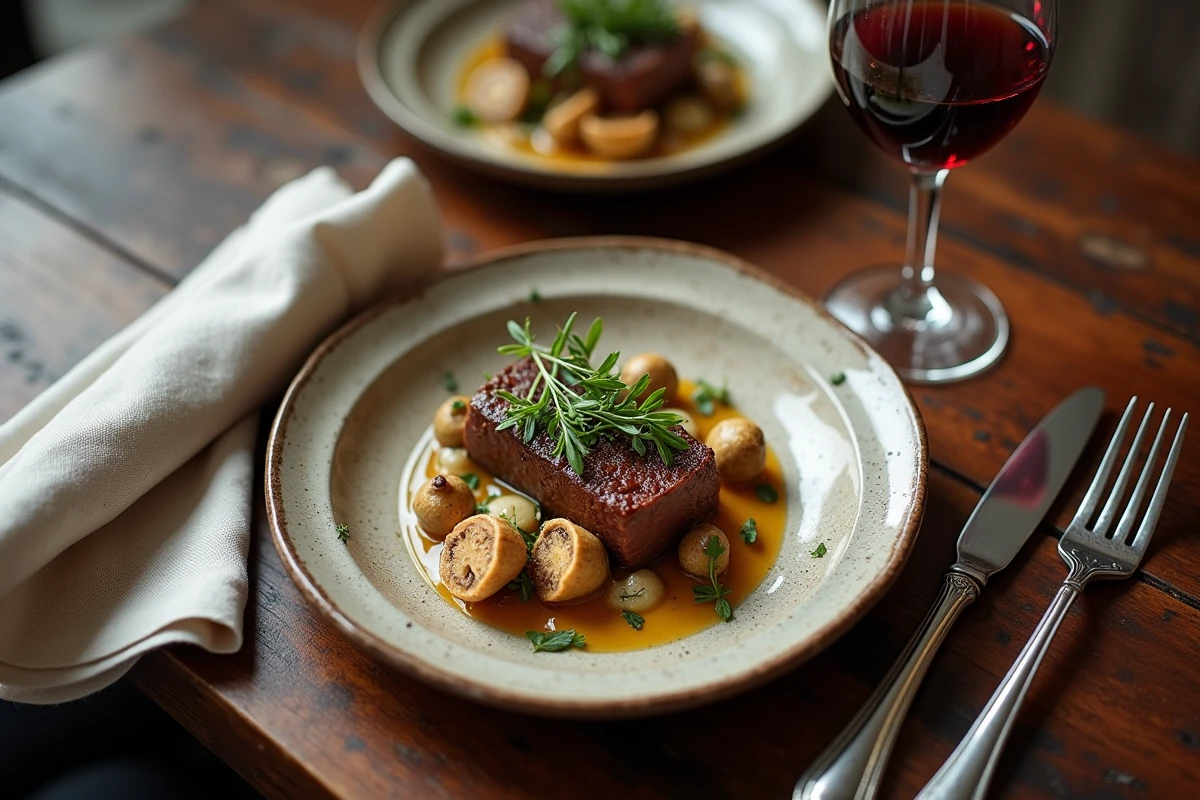
The veal with morels relies on a particular balance: meat with a melting texture, a sauce rich in umami, and an earthy aroma brought by the mushroom. The choice of red wine for this pairing depends less on the region of origin than on the wine’s taste profile, particularly its tannic structure, level of oakiness, and freshness on the palate.
Aromatic profile of morels and constraints for red wine
The morel develops aromas of underbrush, toasted hazelnut, and damp earth, accompanied by a strong umami component when cooked in a creamy sauce. This rich flavor imposes a direct constraint on the wine: a red that is too oaky or too tannic accentuates bitterness instead of rounding it out.
The sauce, often enriched with cream or reduced veal stock, coats the palate. A wine with marked extraction and aging in new oak conflicts with this texture. Dry tannins dry out the mouth, and pronounced oakiness masks the finesse of the mushroom. Those looking to find out which red wine to pair with veal and morels should think in terms of flexibility and aromatic length rather than power.
Recent trends in sommellerie confirm this direction: fresher and less alcoholic reds are favored for gastronomic pairings where the sauce plays a central role.
Comparison of grape varieties and appellations for veal with morels
Not all red wines react the same way to morels. The table below contrasts the most frequently cited profiles for this pairing.
| Grape Variety / Appellation | Tannic Structure | Oakiness | Freshness | Relevance with Morel |
|---|---|---|---|---|
| Pinot Noir (Burgundy, Morey-Saint-Denis, Gevrey-Chambertin) | Soft to medium | Discreet to moderate | High | Very high |
| Pinot Noir outside Burgundy (Alsace, Loire, Germany) | Light to soft | Low | High | High |
| Merlot dominant (Saint-Émilion, Pomerol) | Medium, round tannin | Moderate to marked | Medium | Correct if well-integrated aging |
| Cabernet Sauvignon dominant (Pauillac, Médoc) | Firm to high | Often marked | Medium | Low |
| Northern Syrah (Crozes-Hermitage, Saint-Joseph) | Medium, fine tannin | Variable | Medium to high | Correct on a fresh vintage |
Pinot Noir dominates this pairing for a structural reason: its fine tannin extends the creamy texture of the sauce without cutting through it. Burgundy appellations like Morey-Saint-Denis or Gevrey-Chambertin also provide an underbrush aroma that directly echoes the morels.
Burgundy Pinot Noir or others: what changes in the pairing
Classic recommendations systematically point towards Burgundy. Recent sources broaden the spectrum: a Pinot Noir from Alsace, the Loire, or even Germany (Spätburgunder) can work just as well, provided the style remains fine and lightly oaked.
The difference lies in the terroir and aging. A premier cru Burgundy from the Côte de Nuits offers tertiary complexity (leather, truffle, humus) that amplifies the earthy dimension of the morel. A Pinot from a cool climate outside Burgundy focuses more on fruit and acidity, which is better suited when the sauce is very rich or when the veal is served pink.
Some guidelines for choosing between the two profiles:
- If the sauce is enriched with thick cream and the veal is well-cooked, a Burgundy with a few years of aging (Morey-Saint-Denis, Volnay) provides the necessary depth.
- If the preparation remains light (reduced morel juice, little cream), a Pinot Noir from Alsace or a red Sancerre keeps the pairing in tension without weighing it down.
- If the dish includes other mushrooms or smoky elements, a northern Syrah from a fresh vintage can be a coherent alternative.
The question of vintage and aging
One point that pairing guides rarely mention: a wine that is too young with unintegrated oak aging sabotages the pairing, even if the grape variety is suitable. A two-year-old Gevrey-Chambertin still presents vivid tannins and noticeable oak that oppose the roundness of the dish.
In contrast, the same wine after five or six years develops tertiary notes of underbrush and dried mushroom that merge with the morel. For a tighter budget, a village Burgundy or a Côtes de Nuits-Villages with a few years in the cellar offers a more harmonious result than a premier cru consumed too early.
Bordeaux red wines with veal and morels: a conditional pairing
Bordeaux reds frequently appear in suggestions for veal. The reality is more nuanced. Blends dominated by Cabernet Sauvignon (left bank) present a tannic structure and oakiness that risk overwhelming the morel.
Merlot from the right bank (Saint-Émilion, Pomerol) works better, provided a mature vintage is chosen where the tannins have rounded out. A ten-year-old Pomerol, with its characteristic velvety texture, approaches the required suppleness.
The common pitfall: selecting a Bordeaux based on the reputation of the appellation rather than the wine’s profile. A highly extracted and oaky grand cru Saint-Émilion will yield a less convincing result than a simple village Burgundy with integrated tannins.
The pairing of veal with morels and red wine boils down to a technical detail: the tannin must accompany the texture of the sauce, not compete with it. Wines with soft tannins, discreet aging, and marked freshness remain the safe bet, whether the label bears the name of a Burgundy village or a more unexpected vineyard.